
By Philip Harder
People stumble upon skateboarding in a variety of ways. It’s usually through finding a skate video, or by seeing a sibling/friend skate, or by being gifted a board (the forever present christmas complete still holds immense power). But could that list come to include watching the Olympic games? At this point it’s almost inevitable that it will, with skateboarding’s Olympic debut at the Tokyo 2020 summer games just 4 months out. And as this Jenkem article reveals, there is already a fair amount of kids who accept and even welcome the concept of skateboarding in the Olympics. This is a huge sea change in the perception of events like the Olympics. If you had asked the average skater 10 years ago what they thought about skateboarding being in the Olympics they would have probably laughed in your face. What does this change in perception mean for skateboarding? And what will be the outcome of the introduction of skateboarding into the Olympics?
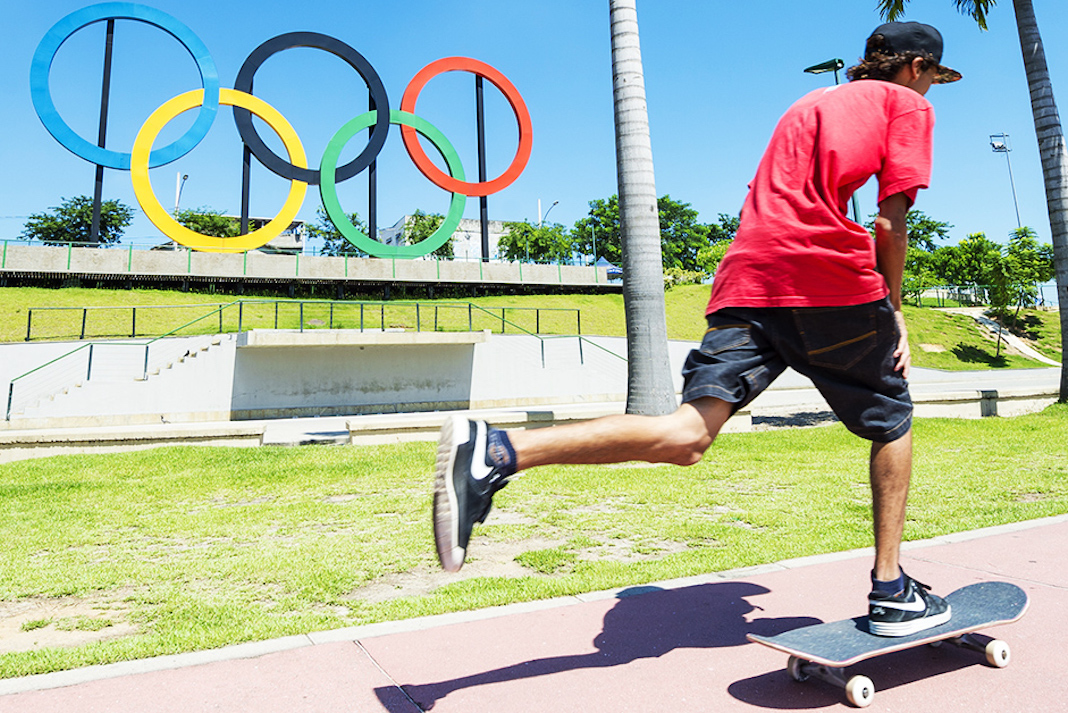
Skateboarding will be portrayed as a sport
One effect that the olympics will have on skateboarding is that it will present skateboarding as a sport to a very broad audience. Although “sport” might not be the best word, maybe a better word would be a “game” since afterall it is called the “Olympic games”. But the semantic difference aside, both words function to represent the structure that contests (especially the Olympics) bear upon skateboarding. And that is most notably of course, a win state and a loss state.
This naively seems to go against the spirit of skateboarding. In skateboarding there’s no coach, no foul plays, no winning of the skateboarding match, it’s just you and your friends having fun. But while this is mainly what skateboarding means to me, let’s be realistic here. Skateboarding is often very competitive, whether it’s through progression with yourself and others, or its through a game of S.K.A.T.E., or if it’s through the myriad of other huge contests that already exist and have existed since the earliest days of skating. So what then is the problem with the Olympics? Well as Emmanuel Levinas might put it, the Olympic games will present a totalizing conception of skateboarding. Sure skateboarding has always had elements of competition, as any physical discipline will inevitably have. And sure contests have been ever present in skateboarding, but skateboarding has never been JUST been about contests. Most early contests were simply used as ways to facilitate the viewing of good local skateboarding. There was no youtube, or instagram, you had to get out and organise an event in order to see your local pro skaters.
Skateboarding is a lot of things to alot of people, it’s a community, an artistic medium and outlet, a meditative and therapeutic act, it’s a culture and (as corny as this sounds) a lifestyle. I would go so far as to say that skateboarding can be a mode of thinking. You won’t be able to present any of that to viewers of the Olympics, through an Olympic style format, it just can’t be done. So what will effectively happen is that for the first time ever, skateboarding will be broadcast all over the world to billions of people who have no idea what skateboarding really is. And when they see this presentation of skateboarding they will associate skateboarding with, contests, nation-state glory, and winning and losing. I’m already aware that these phenomena appear in skateboarding culture today, but what’s concerning is that most people who skateboard don’t think about these things at all. Most average skateboarders don’t have their minds preoccupied by contests and competition when they skate. In fact almost no skaters do, there’s only a select group of extremely skilled skaters that really think of skateboarding as a competitive sport. And that’s only because it’s their job to win contests, so their economic freedom depends on that conception of skateboarding. There are around 11 million people who skateboard (according to Glenn Brumage). There were 3.6 billion viewers of the last summer Olympics (according to statista). This means that within one airing of a skateboard contest, there could be billions of people that think of skateboarding in this totalizing way. That’s 3 orders of magnitude more than all active skateboarders today. I’m not saying that something drastic is going to happen overnight, but it’s clear that the impact that the Olympics could have on skateboarding may far exceed any internal forces that have previously shaped skateboarding into what it is today.
Skateboarding will have more corporate friendly power structures
They say that history often repeats itself, and if this is to be true then we should look to the past to see if any historical examples have presented themselves with compelling parallels to the current situation with the Olympics. One such parallel, is the snowboarding community. Snowboarding was first introduced into the Olympics in the 1998 Nagano winter games. The IOC (the International Olympic Committee) decided that they needed more action sports in the winter Olympics in order to boost ratings. They needed snowboarding and they needed it quickly, so they turned to the FIS (International Ski Federation). Yes that’s right a bunch of cross country skiers were in charge of organizing the first showing of snowboarding at the Olympics. At the time, snowboarders themselves were actually organizing their own federation, called the International Snowboard Federation (ISF). But that federation was quickly choked out by the FIS who had the money and connections to take away TV broadcasts of ISF events, and start hosting their own Olympic qualifiers. Terje Haakonsen (who was at one point arguably the best pipe rider in the world) sums up the effects that the olympics had on snowboarding like this:
“You see, action sports is commercial value. So the Olympics want action sports because it is way more commercial money for them. Everybody knows that. The thing is you have guys directing the sport who don’t actually do the sport – people who are just in it for the commercial interest. You don’t have the athletes involved who actually know about the sport that can make better progress in the sport, that can experiment with the sport, and make their snowboarding life a lot better. It’s all about sports politics and commercial interest.”
This seems to be the main problem with the Olympics, they only want in on broadcasting snowboarding and skateboarding because it’s a potential money maker. This means that whatever the executives in a boardroom think is the best way to make money, and to make it fast, is what’s going to happen. Unfortunately short term profits often come at the expense of the people that labor to make those profits, meaning that the people who are apart of these communities that helped make snowboarding what it is, get the short end of the stick. And indeed the more core community of snowboarders has withered along with overall ridership in recent years.
I’m still not sure if snowboarding is headed for an imminent death, but it certainly seems to be on that path right now, and it’s obvious that the oversaturation that was fuelled by the Olympics helped guide it to that path. So is this where skateboarding is headed with its Olympic debut? Well it certainly seemed like it in early 2016 when the International Federation of Roller Sports (FIRS) looked poised to claim to be the governing body of skateboarding. Yes that’s right, a bunch of rollerbladers were the ones who wanted to structure the Olympic debut of skateboarding.
Thankfully history did not repeat itself. And instead a group of skateboarders coalesced to form the International Skateboard Federation (ISF, no relation to the previous snowboarding ISF, and yes I’m just as tired with these acronyms as you are). With notable members like: Tony Hawk, Chris Miller, Tod Swank, Gary Ream (owner of woodward), as well as Dave Carnie of Big Brother notoriety. Which is interesting, considering just how core some of those people appear to be. Carnie is in fact an outspoken critic of the mainstreaming of skateboarding, and an original dissenter to the idea of skateboarding in the Olympics.
It’s great that we have some representation from people who are actually in our community, but I’m skeptical of their reasoning to continue to work with the Olympics. As carnie puts it: “Skateboarding is going to be in the Olympics whether we like it or not.” So I guess the line of reasoning goes like this: skateboarding will be co-opted no matter what happens so skateboarders might as well mediate that co-option ourselves. But I’m not sure if I agree with this line of reasoning, sure the Olympics will choose any governing body that will play ball with them to get skateboarding, but even if they chose the FIRS to represent us they still need the skaters themselves.
As Hegel would put it, the master needs the slave more then the slave needs the master. If we really didn’t like the conditions under which the Olympics presents skateboarding then all we have to do, is not participate in the Olympics. Of course though to do that we would need some sort of democratic organization to reach this conclusion, and build alternative economic institutions in order to make sure that the money of the IOC doesn’t outway the will of the skateboarding community.
Then again, it might not be the worst thing for skateboarding to be presented to billions of people, as long as it’s presented in a fashion we deem to be representative of the core of skateboarding. It could even still be a contest, think of how exbruent and amazing something like the Dime Glory Challenge is. Now think about how amazing it would be to give the glory challenge an Olympic style budget and to have it be broadcast to billions of people. That would be much more representative of skateboarding as a whole, and I would be willing to bet that it would actually get much more viewership than some sanitized half baked traditional Olympic style contest. So why doesn’t the ISF negotiate for that outcome? Well the Olympics is a business, it has sponsors and products to sell, and marketing to push. I’m not sure that the chaotic energy of a Dime Glory Challenge would be appealing next to a Mcdonalds advertisement. So then we’ve reached an impasse, because the IOC wants the youthful branding of the skateboarding community without the subversive attitude that this youthful spirit entails. You can’t have it both ways ladies and gentlemen, so there is no way that either party is going to be happy.
The ISF insists that they’re negotiations to make the Olympics essentially another street league contest just with Olympic branding is the best possible result. I don’t see how that adds up. And when you consider the fact that people like Gary Ream, owner of woodward, will be getting a lot of benefits from mainstream and corporate investments into skateboarding infrastructure, then I begin to wonder about the motivations behind this agreement. Because right now it seems like the only organization that represents skating, is trying to make sure corporate money comes into skateboarding, but in a way that doesn’t look corny. History may not repeat itself but it often rhymes.Let’s not forget the constant push for corporate involvement that people like Tony Hawk have pushed for. You can take the bagel bites out of the sponsorship but you can’t take the sponsorship out the bagel bites. What I’m trying to say is that, the aesthetics of the Olympics doesn’t really matter. Whether it looks and feels corny or not, it’s still a capitulation to corporations that want nothing to do with us unless there is money to be made. And the skateboarding community might be getting a fair cut of that money today, but that might not be the case in the long run. Either way, I think that the ISF has underplayed it’s negotiating position. And it has not taken into account the opinions of the skateboarding community as a whole, in making this decision. Skateboarding needs some sort of non-partisan, non-corporate, democratic organization willing to abstain from potential profit making opportunities in order to preserve and evolve the worthwhile parts of the skateboarding community. We don’t need, an organization full of businessmen, and the skateboarding 1% to tacitly negotiate out the more distasteful details of corporate arrangements.
A culture of “by skaters and for skaters” is changing
Some of this may sound alarmist, and while I think it’s possible that the olympics could really mark the start of the end of skateboarding, I don’t think that it’s entirely probable. The very existence of jed anderson, is a refutation that all of core snowboarding is dead, and who knows, maybe in this time of darkness and lack of corporate sponsorship snowboarding will be able to rebuild its culture to be something even greater then it was before. Afterall skating itself has gone through cycles like this, where it has been a public fad with mainstream attention, only to collapse in on itself like a wall street bubble. And out of those collapses skateboarding has stayed alive.
The Olympics will be a huge bubble, and only time will tell if skateboarding has the capacity to recover after this bubble pops. But considering how accessible skateboard-able terrain is and how plentiful supplies are right now, I would be willing to bet that skateboarding could survive such a pop. With snowboarding you need land on a mountain and a fiberglass pressed board, with skateboarding all you need is a flat surface and a piece of wood with wheels. The slight specialized nature of snowboarding makes it ripe for capital to take over and enforce it, but the universality of skateboarding makes it harder for this to happen fully. What this means is that we don’t need corporations with millions of dollars to buy a mountain and help maintain it for us. We have the streets, the sidewalks, the plazas, all of the spaces in which skating can be done, are all already out there in the wild waiting to be skated. Skateboarding has at least partially freed itself from corporate entities in its spaces, its equipment is another question, but nonetheless this is an important realization. A Lot of what skateboarding needs to be sustained can simply be done by the skateboarders themselves without outside involvement. Building skateparks, making magazines, pressing boards, all of this has traditionally been preferably done by skaters, and for skaters.
As Tony hawk once said: “The Olympic Games need skateboarding more than skateboarding needs them”. If this is to be true, and I believe it to be, then why are acting like we need the Olympics to help sustain skateboarding? Why are people all of the sudden so ready to reach out to entities who we know have the ability to exploit us? Is it simply because we want skateboarding to keep growing? I’m sure we all want to see more people on boards, skating, making videos, etc. but at what cost? When everyone in skateboarding is just in it, to be the coolest, highest paid, most contest winning skater, what will happen then? Well everyone can’t be the best, so once people start realizing that they’re not the best they’ll start quitting. Skating won’t be able to sustain itself unless it has people in it’s community ready to stay in skateboarding even if they suck at it. More often than not, the best filmers are the most mediocre skaters. Likewise the best skatepark designer doesn’t have to be the best pool skater. But we need both of those people in our community in order to sustain the act of skateboarding itself. We need people to keep skating even if they can’t win a contest.
This is the paradoxical nature of skateboarding (and of most things), you only succeed by failing. You can only land a trick by trying and failing at it many many many times. Likewise with skateboarding itself, it will only live if it dies. Like Jason Jesse once said “I love skateboarding so much I want it to die.” We have to have the courage to possibly let skateboarding die. If it means turning down the Olympics then so be it. And maybe this death will bring a rebirth. What I’m really worried about is that the olympics will lead to a death that will not be remembered fondly. I’d rather have skateboarding stick to it’s core ideals and die as the world changes, then see the world’s changing ideals get integrated into skateboarding effectively killing itself. I don’t want to see the death of our own culture because we were persuaded to be more corporate. For me it’s all or nothing, and I want us to go out on our own terms.
Further reflection
I don’t think the Olympics will be a total death sentence for skateboarding but I’m sure it will have many adverse consequences, many of which may not be known until it’s too late. The skateboarding community has apparently come to a consensus on the legitimacy of skateboarding being in the Olympics, but I think it’s time for a re-examination. If not for skateboarding, then at least for the fact the Olympics itself is a destructive corporate institution.
I think we all need to take another look at how skateboarding being in the Olympics will affect this community. Is there really a consensus in our community that this is a good idea? Is it worth exposing more people to the act of skateboarding even if it means that skateboarding will be presented as a corporate sport? Is an organization like the ISF really beneficial to the skateboarding community? Sound off in the comments with your thoughts, and opinions.
 marketphilipharderskateboard.sport.blog
I think it’s good that skating is now being considered in the Olympics. Sports companies like Adidas have made big strides in representing street skaters and making the pro.
LikeLike